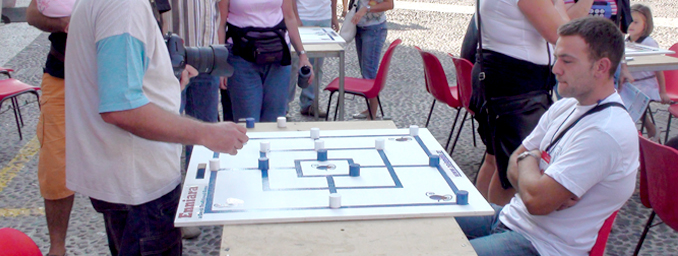
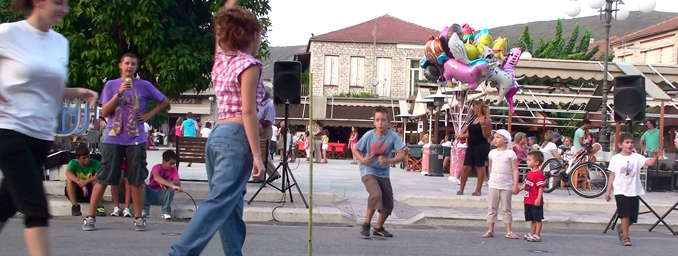
The game is an activation of the physical and mental forces of the individual for exercise, fun, rest, etc.
It is distinguished from work for the reasons that dictate it. It is a feature of all human races, even animals with higher mentalities. As an object of research and study, the game has occupied Pedagogy, Child Psychology, Folklore and other fields of cultural history and divergent theories have been formulated about its principle, character and expediency.
The game is closely linked to childhood which is its main feature.
By definition, which is based on empirical observation, play is spontaneous and free engagement, which does not aim at a specific purpose, is an end in itself and usually causes pleasant emotions.
 Of course, the definition can not answer the big questions if the player is driven by some inner need, so he does not act freely, if he does not really pursue, albeit unconsciously, some purpose. Thus theories that play is a way of rest and recreation or the result of excess energy of the individual or even that it is a remnant of acts of obsolete generations that are inherited to the individual (theory of atavism) give one-sided answers to the issue.
But the child does not play only when he is relaxed to spend the excess energy. He plays when he is tired, even when he is sick.
The instruments used by children for their toys, the playthings of the ancients, were many and varied.
 Constructions originally, or inventions of the children themselves or their parents, today are the objects of handicrafts or industry. The raw material used was wood, clay, fabric, paper, leather, metal, wax, which were processed by special craftsmen. They usually represent figures (dolls, soldiers, athletes, etc.) or scenes of human life, animals, furniture and utensils, buildings, imitations of musical instruments, means of transport (ships, cars, planes). The toy industry is today one of the most lucrative sectors of the industry due to the overemphasis on the pedagogical and cognitive value of the toy. But in antiquity and in all peoples - primitive and non-primitive - the game was a kind of craft activity especially important.
Of course, in its simplest form the game consists of raw material (sand, soil, balls, groups, wood, stones) or old and useless materials (wreaths, hoops today), spheres (landscapes, balloons, balls), whirlpools, fabric dolls (logs).
Children were given, as today, toys at birth (eyeglasses), birthdays (birthday installments), New Year (gifts), initiation of the child into certain worship and other occasions.
The features, formal or diapers were amulets (amulets) and jewelry that hung on the baby's bed.
The platagones, platagai, or seistra, invented, perhaps, by the great engineer of the 5th century BC century Archytas, were circles with bells, vases or hollow figurines filled with balls to ring (rattles). Such toys have come to light with excavations. The children themselves, on the other hand, built houses with clay, carts, wooden boats, furniture, animals, etc. The cone (Homer), the vembix, the ring or wheel, the sphere, the plumber, the wooden or clay or wax nymphs or daughters or planks, in the construction of which the koroplathoi specialized, are some of the toys of the ancients. High-tech games were nerve-wracking.
The great development of the toy industry coincides with the industrial revolution. It should be noted here that the technology of the game precedes the industrial technology often with a difference of centuries (Heroes Alexander). New advances in technology (bicycle, telegraph, electricity) are now being used to make toys that actually mimic modern reality. In the 20th century the effort of the gaming industries tends towards the faithful rendering of reality and accuracy.
Today's games that children play (if they play) and that reflect our moral and social status, have characteristics completely different from the features of our Traditional games. The modern way of life in big cities, with the complete submission of society to the demands and orders of consumerism, with the constant and almost exclusive effort to maximize our economic potential, with our distance from tradition, with the complete absence of places of exercise and recreation , with the impossibility of finding free time for fun and engaging in the pleasures and pleasures, both from the older ions, and unfortunately especially from the children, formed new and in a very dubious if not dangerous way games and children, that trouble intensively the scientists - Sociologists, Educators of every level, Psychologists etc. - and for their value and for all that is left in the physical, spiritual and mental condition of young people.